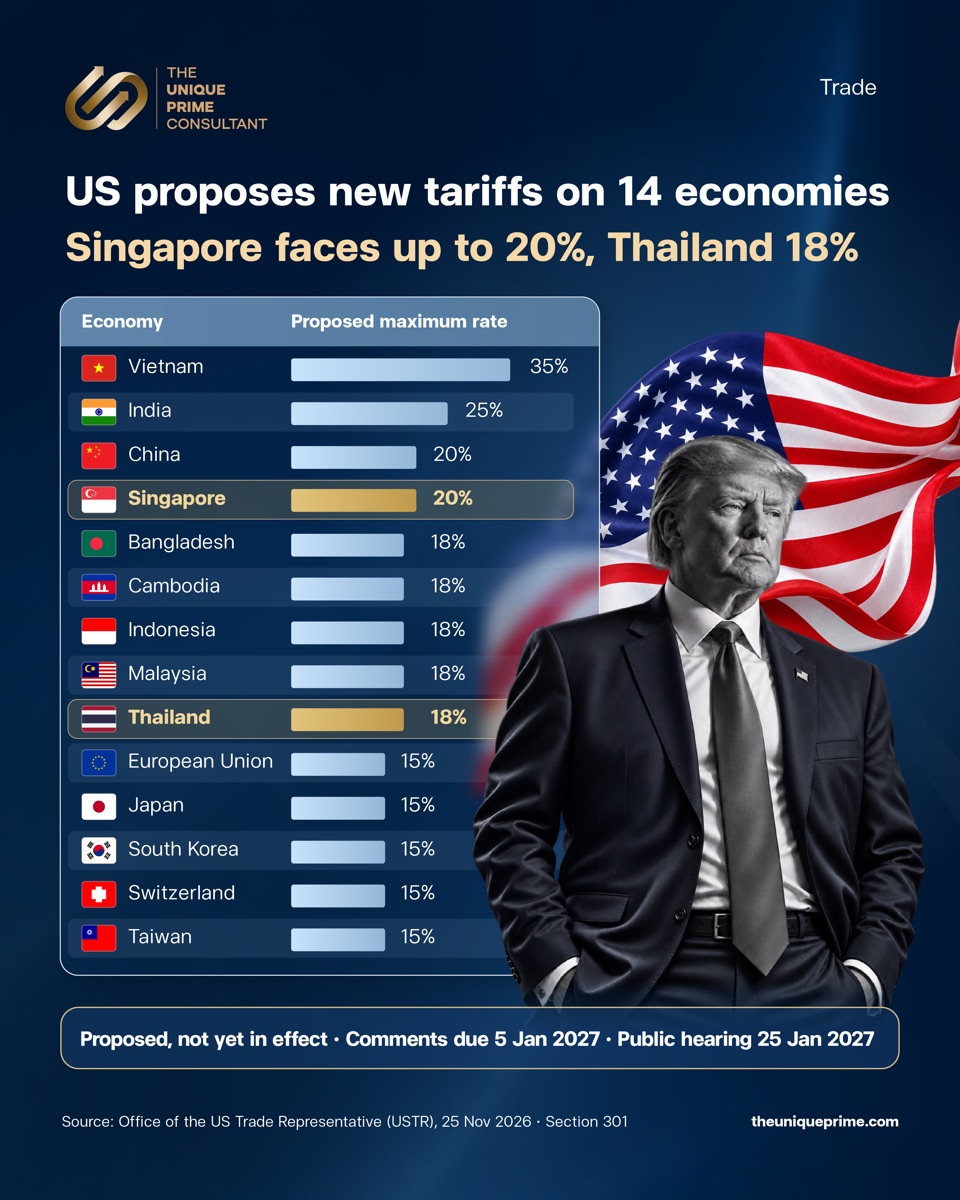
On 25 November 2026 the Office of the US Trade Representative (USTR) proposed new Section 301 tariffs on goods from 14 economies it found to cause structural excess capacity in manufacturing. Proposed rates are up to 35% for Vietnam, 25% for India, 20% for China and Singapore, 18% for Bangladesh, Cambodia, Indonesia, Malaysia and Thailand, and 15% for the European Union, Japan, South Korea, Switzerland and Taiwan. They are proposals only and not in effect: public comments are due 5 January 2027 and public hearings begin 25 January 2027.
Proposed rates by economy
| Economy | Proposed rate (up to) | Other rate named in the notice |
|---|---|---|
| Vietnam | 35% | Could be lowered to 20% with a trade agreement |
| India | 25% | Could be lowered to 17% with a trade agreement |
| China | 20% | Up to 10% for some goods, some exempt; up to 40% if talks are unsatisfactory |
| Singapore | 20% | Could be lowered to 10% with an agreement |
| Bangladesh | 18% | Up to 20% if talks are unsatisfactory |
| Cambodia | 18% | Up to 25% if talks are unsatisfactory |
| Indonesia | 18% | Up to 25% if talks are unsatisfactory |
| Malaysia | 18% | Up to 25% if talks are unsatisfactory |
| Thailand | 18% | Up to 25% if talks are unsatisfactory |
| European Union | 15% (flat) | Up to 20% if talks are unsatisfactory |
| Japan | 15% | Up to 20% if talks are unsatisfactory |
| South Korea | 15% | Up to 25% if talks are unsatisfactory |
| Switzerland | 15% | Up to 20% if talks are unsatisfactory |
| Taiwan | 15% | Up to 25% if talks are unsatisfactory |
Each notice lists products that would be exempt, and most rates are net of existing Section 301 tariffs. Rates and coverage may change after the comment period and hearings.
What USTR found
USTR investigated 16 economies from March 2026 and determined that policies in 14 of them, such as industrial plans and production targets, preferential lending and subsidies, cause structural excess capacity and production in manufacturing. Mexico and Norway have no determination yet.
Key dates
- 25 November 2026: determinations and proposed actions announced.
- 5 January 2027: deadline for written comments and requests to appear at the hearing.
- 25 January 2027: public hearings begin.
What it means for Thai and Singapore businesses
Exporters selling into the US may want to review pricing, contracts and supply chains with their trade and customs advisers now, while the rates are still proposals. Where goods are made, not where the selling company is registered, generally decides their origin under US customs rules, so restructuring a company does not by itself change the tariff on a product. For regional structure, banking and company questions, see company incorporation; customs and trade law advice comes from licensed specialists we can introduce.
Source: Office of the United States Trade Representative, “USTR Makes Determinations and Proposes Actions in 14 Section 301 Investigations” (25 November 2026), ustr.gov, and the 14 country notices. Proposed, not yet in effect.
For education only, not investment, legal or tax advice. Planning is coordinated through licensed professional partners.
Reviewing your regional structure?
A senior consultant will respond within one business day. Every conversation is confidential.